
Upper third
Forehead and temples form the narrowest horizontal zone.
Face shape balance guide
A triangle face shape is strong below: a narrower forehead flows into a broader jaw. The aim is never to erase that strength; it is to understand where hair, frames and contrast place the viewer's attention.
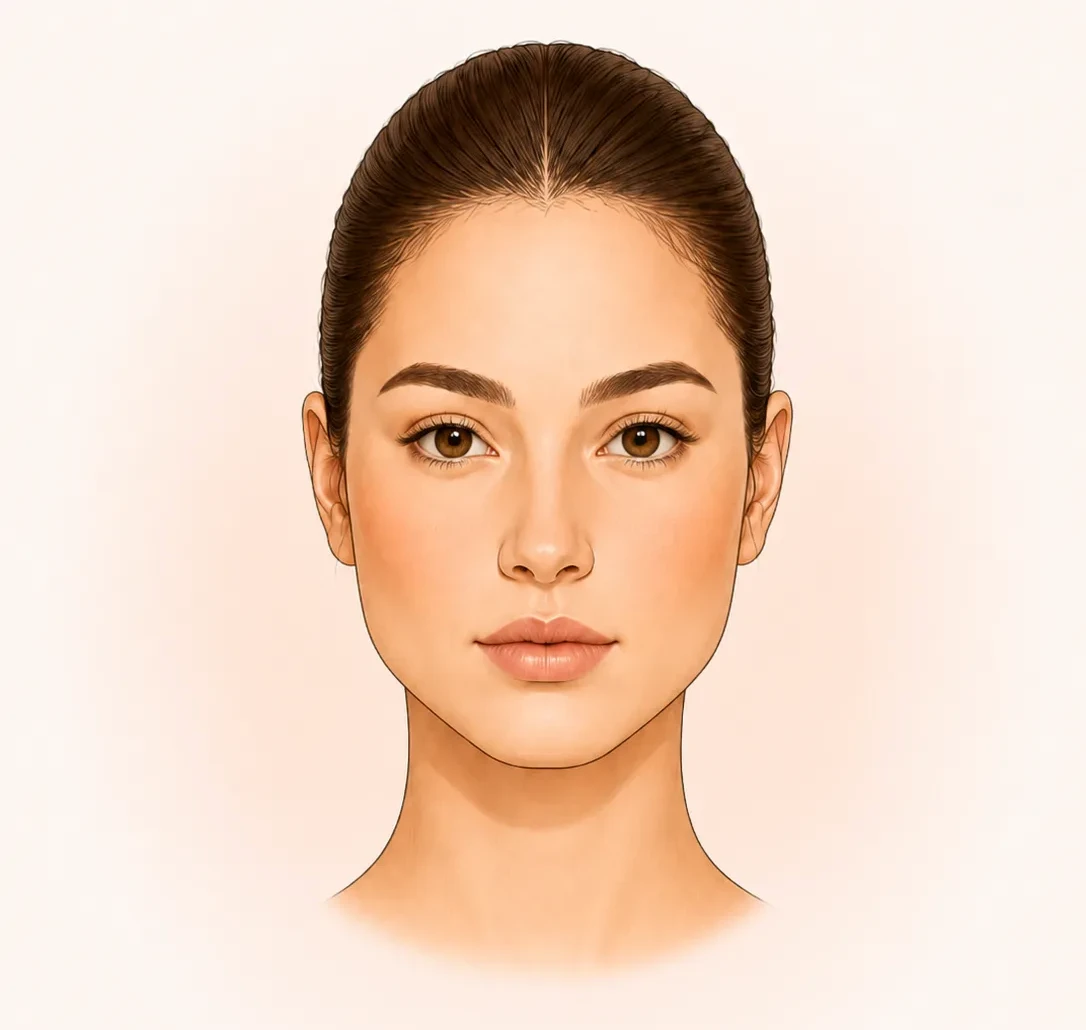 narrower herewidest here
Read top against bottom
Pull hair away from the forehead and use a straight-on photo before you claim the label. Look for a consistent outward taper from temple to jaw; the category is an outline, not a judgement about weight or attractiveness.
Forehead and temples form the narrowest horizontal zone.
Cheekbones begin the outward flow but do not usually exceed the jaw.
Jaw corners create the broadest, most visually grounded line.
Exact opposite taper
Heart is broad across the forehead and narrows to the chin. Triangle begins narrower and becomes broad at the jaw.
Shared strong jaw
Square keeps similar width at forehead and jaw. Triangle's upper third is visibly narrower, even when both jawlines look angular.
Four numbers, one taper
A soft tape measure settles arguments a mirror cannot. Take each width twice, keep the tape level, and compare directions rather than chasing exact centimetres — the shape is defined by which number wins, not by the numbers themselves.
The verdict: if the jaw measures widest and the forehead narrowest, you are looking at a triangle face shape. If the forehead wins instead, the taper runs the other way — read that as heart, not triangle.
Measure across the widest part of the forehead, about halfway between the eyebrows and the hairline. On this outline it is usually the smallest of the three widths.
Run the tape from the sharpest point below one outer eye corner to the matching point on the other side. Expect a value between the forehead and the jaw.
Measure from just below one ear, across the widest part of the jaw, to just below the other ear. When this number clearly leads, the triangle reading is likely.
Measure from the centre of the hairline to the chin tip. Length matters less here than in an oval or oblong read — the triangle call rests on jaw versus forehead, whatever the length.
Visual weight map
Switch the styling layer. The bars show where each choice places visual emphasis—not a measurement of your face.
Hair
Try this
Try a textured crop, curtain fringe, crown layers or width at the temples. Keep the ends from forming a heavy shelf exactly at the jaw.
Why it changes the read
The silhouette introduces detail where the face is narrower, so the jaw remains strong without being the only wide horizontal line.
From crop to collarbone
A textured crop, a pixie with a longer fringe or a soft quiff all build their interest through the crown and temples — exactly where a triangle face shape is narrowest. Ask for weight kept through the top, and avoid clipping the sides so close that the jaw becomes the only wide line left.
Collarbone cuts flatter this face shape when the layers start at cheekbone level and swing outward, so the movement happens above the jaw rather than pooling at it. A curtain fringe adds width at the temples; a deep side part does the same with less commitment.
Long hair works when interior layers lift the mid-lengths. Skip the single blunt hem that lands exactly at the jaw corners; dropping it below the collarbone, or adding face-framing pieces from the cheek down, keeps the widest point of the cut away from the widest point of the face.
The same logic applies vertically: keep fullness and texture up top and fade the sides gradually rather than abruptly. If you wear a beard, taper it at the jaw corners instead of letting it square off an already broad base.
Useful salon and optical language
Hair“Keep movement through my temples and crown; do not land the widest blunt edge on my jaw.”
Frames“Show me an upper-accented frame, then check bridge fit and temple pressure.”
Finish“Keep definition high and outward; I do not want a harsh stripe carved along the jaw.”
Names and nuances
A triangle face shape is widest at the jaw and becomes narrower toward the forehead. It is also called a pear face shape. The jaw may be angular or softly rounded; the key is the direction of the taper, not whether the chin is pointed.
No. They are opposite tapers. Triangle is widest at the jaw and narrower at the forehead, while heart is widest at the forehead or cheekbones and narrows toward the chin.
Both can have a strong jaw. On a square face, the forehead and jaw are close in width; on a triangle face, the forehead is visibly narrower than the jaw. Compare the top and bottom thirds rather than judging the jaw alone.
If you want a more balanced outline, add texture or width at the crown and temples, and avoid placing the heaviest blunt line directly at the jaw. A side-swept fringe, layered crop or volume above the cheekbones can all work, adapted to your hair texture.
Frames with a strong browline, cat-eye lift or detail at the upper outer corners draw attention toward the eyes and temples. Choose a frame that fits the bridge and stays close to the face's width; visual balance does not compensate for poor fit.
Yes. The label is read the same way on any face: the forehead is narrower than the jaw. For men the most common styling question concerns the beard — full bulk at the jaw corners widens the base further, while a beard trimmed slightly closer at the corners keeps the outline in proportion.