
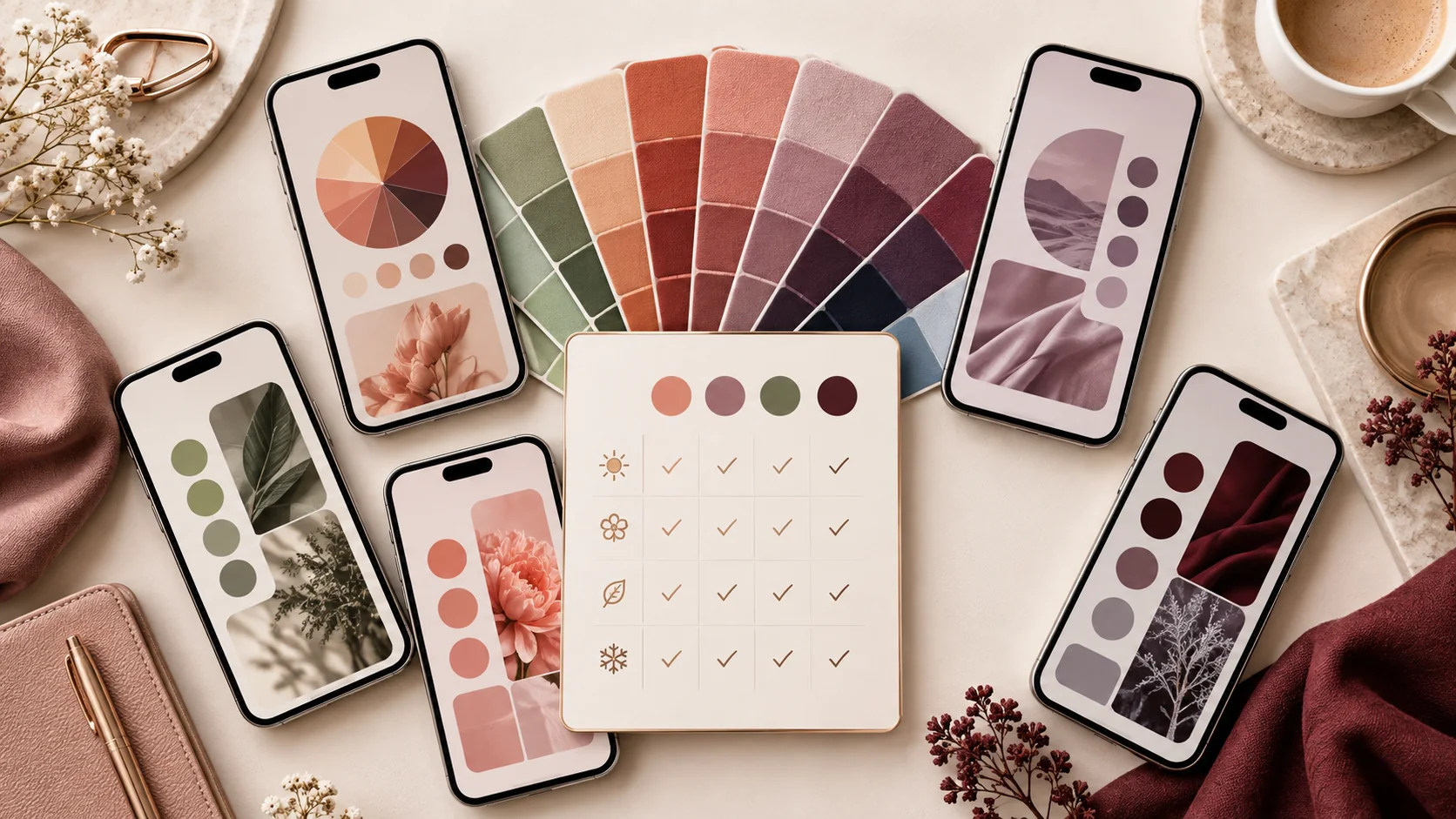
All Seasons
Best Color Analysis App 2026: 7 Tools Compared
The best color analysis apps of 2026 compared by input, result, price, privacy, and real use case—with honest strengths, limits, and who each tool suits.
Sep 24, 2026 · 13 min read

Aiyi is the founder and lead editor at Color Season AI. With a background in visual design and a personal obsession with seasonal color theory, she writes in-depth guides that blend research with real-world styling advice.
Soft Autumn and Soft Summer are the two most frequently confused seasons in the 12-season color analysis system. Both sit in the "muted" zone — low-saturation palettes that feel dusty, gentle, and never loud. If every online quiz gives you a different answer, you are probably one of these two.
The confusion makes sense. Soft Autumn vs Soft Summer palettes share the same mutedness level, similar depth range, and even overlap on a handful of colors. From a distance, a dusty sage outfit could belong to either season.
The single variable that separates them is undertone. Soft Autumn runs warm — golden, earthy, amber. Soft Summer runs cool — rosy, ashy, blue-grey. That one degree of difference changes which shades illuminate your skin and which ones flatten it.
This guide walks through every category where soft autumn vs soft summer palettes diverge, shows where they overlap, and ends with a self-test so you can settle the question for good.

Color analysis works on three axes: undertone (warm or cool), saturation (bright or muted), and depth (light or dark). Soft Autumn and Soft Summer match on two axes — both are muted, both are medium depth — and diverge on the third.
Soft Autumn is warm-muted. Its palette leans into golden yellows, earthy browns, and olive greens. Skin typically has a warm, golden quality — think peach or honey undertones in natural light.
Soft Summer is cool-muted. Its palette revolves around dusty roses, powder blues, and ashy mauves. Skin reads pink or neutral-cool — cheeks flush rosy rather than peach, and veins tend toward blue-purple.
The easiest way to spot the difference: hold a warm terracotta scarf and a cool dusty rose scarf against your bare face in daylight. The one that makes your skin look clearer and more alive is your season.
Abstract talk about "warm vs cool" only goes so far. Here is every major color family compared side by side — the exact shade each season uses, and why one works where the other does not.
Notice the pattern: every Soft Autumn shade pulls yellow, golden, or earthy. Every Soft Summer shade pulls pink, grey, or blue. The saturation levels are nearly identical — it is the temperature that shifts.
For complete color breakdowns, see the full Soft Autumn color palette and Soft Summer color palette guides.

Not every color is a hard boundary. Soft Autumn and Soft Summer overlap on a narrow band of neutral-muted tones — shades that sit right on the warm/cool border. If you can wear all of these comfortably but struggle with the extremes of either palette, you are probably in this overlap zone.
These shared shades are often described as "mushroom," "greige," or "dusty sage" — colors that resist being labeled warm or cool.
Soft Autumn Only
Soft Summer Only
The overlap zone is safe territory if you are still deciding between soft autumn vs soft summer. Build your wardrobe core with these neutral-muted shades and add season-specific accents (terracotta or dusty rose) as you narrow down your type.
The danger zone is the opposite ends: Soft Autumn exclusives like rust and camel will wash out Soft Summer skin, and Soft Summer exclusives like powder blue and lavender will make Soft Autumn skin look sallow.
Seeing full outfits side by side makes the soft autumn vs soft summer difference tangible. Below are four common dressing scenarios — each shows how the same style formula produces a different feel depending on whether you fill it with warm or cool muted tones.
Soft Autumn
Soft Summer
Soft Autumn
Soft Summer
Soft Autumn
Soft Summer
Soft Autumn
Soft Summer
The same silhouette, the same formality — completely different energy. Soft Autumn outfits feel warm, grounded, and earthy. Soft Summer outfits feel cool, airy, and romantic.
For detailed outfit formulas for each season, see the Soft Autumn outfit guide and Soft Summer outfit guide.

Makeup is where the soft autumn vs soft summer difference is most visible — the wrong lip shade or blush can instantly make your face look muddy or ashy. Here is a category-by-category breakdown.
Foundation
Warm Beige
#D4B896
Cool Beige
#D4C0B8
Warm-neutral with golden undertone
Blush
Muted Peach
#D4A088
Dusty Rose
#C4A4A4
Warm peach with terracotta edge
Lip Color
Warm Nude
#C8956C
Cool Nude
#C9ADA7
Peachy-brown, MAC Velvet Teddy
Eyeshadow
Bronze
#A0805A
Taupe
#9B8E8E
Warm metallic with golden shimmer
Brow Pencil
Warm Brown
#8B6B4A
Ash Brown
#7B7070
Soft brown with amber undertone
Highlighter
Champagne
#E8D8B8
Icy Pink
#E8D8D8
Warm gold with peach glow
The quickest makeup test: apply a warm peach blush on one cheek and a cool dusty rose blush on the other. The one that looks like a natural flush — not painted on — points to your season.
For specific product recommendations, see our Soft Autumn lipstick guide and Soft Summer lipstick guide.
Clothing colors are helpful, but hair color and jewelry preferences can be even more diagnostic for soft autumn vs soft summer. These are areas where your instincts are often already correct — you just may not have connected them to your season.
Natural Hair
Best Highlights
Best Metal
Worst Metal
Soft Autumn hair has warm, golden undertones even when dark — think chestnut, warm brown, auburn. Soft Summer hair reads ashy and cool — mousy brown, mushroom, and cool dark blonde.
For metals, Soft Autumn gravitates to matte gold, antique brass, and rose gold. Soft Summer reaches for silver, white gold, and platinum. If you look better in gold jewelry, you are likely warm (Soft Autumn); silver, likely cool (Soft Summer).
For full guides: Soft Autumn hair color and Soft Summer hair color.

Answer each question honestly based on what you observe in natural, indirect daylight — not under bathroom LEDs or store fluorescents.
If pure white looks harsh and cream looks harmonious → lean Soft Autumn. If cream looks yellowed and white looks clean → lean Soft Summer.
Mostly green or olive-toned → Soft Autumn. Mostly blue or purple → Soft Summer. Mixed → you are in the overlap zone, continue to the next questions.
Terracotta makes your face glow → Soft Autumn. Dusty rose makes your face glow → Soft Summer. Both are okay but neither is stunning → you may need to test deeper — try rust vs powder blue next.
Golden, amber, or red highlights visible → Soft Autumn. Ashy, mousy, or no warm highlights → Soft Summer. This test works best on virgin or grow-out hair closest to the root.
Gold makes your face radiant, silver washes it out → Soft Autumn. Silver makes your face pop, gold looks heavy → Soft Summer. Both are fine → you sit right on the border and will look great in the shared colors from the overlap zone.
If you scored 3 or more in one direction, you have a clear answer. If it was close (2–3), you sit near the warm-cool borderline where both palettes partially work — focus your wardrobe on the overlap colors and use accessories to push warm or cool.
For a definitive answer, try our AI color analysis — it reads your skin undertone from a selfie and places you in the precise 12-season type, removing the guesswork.
Here is the complete soft autumn vs soft summer palette comparison condensed into a single view. Hover over any segment to see the color name. Notice how the Soft Autumn bar trends warm and earthy while the Soft Summer bar trends cool and ashy — but both share the same muted quality.
Quick Summary
Soft Autumn = warm + muted + medium depth. Soft Summer = cool + muted + medium depth. Same mutedness, same depth, opposite undertone. When confused, test with terracotta (warm) vs dusty rose (cool) — the one that makes your skin glow is your season.
If you look at the two bars and one of them immediately feels "yours," trust that instinct — it usually means your eye has already matched its warmth or coolness to your own skin tone without conscious analysis.
These are the traps that keep people oscillating between the two seasons for months. Each one has a straightforward fix.
Testing colors under artificial lighting — warm bulbs push everything warm, cool LEDs push everything cool
Always drape colors in indirect natural daylight near a window. Indoor lighting biases your perception by up to 2 seasons on the warm/cool axis.
Comparing to celebrities instead of your own skin — "I have brown hair like a Soft Autumn celebrity, so I must be Soft Autumn"
Hair color is one data point, not the answer. Focus on undertone tests (vein color, gold vs silver, white vs cream) which are more reliable than hair matching.
Wearing both palettes and choosing the one that gets more compliments — compliments reflect other people’s taste, not your coloring
Instead of asking "which do people like?" ask "which makes my face look healthier, clearer, and more alive in the mirror?" That is the objective test.
Overthinking the overlap zone — if mushroom and sage work for you, panicking that you cannot determine your season
If shared colors work, you are correctly identified as muted. Focus on the extremes: can you wear terracotta or does it yellow your face? Can you wear powder blue or does it grey you out? The extreme test settles it.
Most people who struggle with soft autumn vs soft summer are testing under bad lighting conditions. Fix the lighting first — it resolves over half of uncertain cases immediately.
For more on colors that specifically clash with each season, read our Soft Autumn colors to avoid and Soft Summer colors to avoid guides.
If you have read this far, you now understand the soft autumn vs soft summer framework: same mutedness, opposite undertone. The five-question self-test gives most people a clear answer. For those still on the fence, AI photo analysis can evaluate your visible undertone, depth, clarity, and contrast with less subjectivity.
Whichever season you land on, start with the overlap colors — mushroom, greige, dusty sage, muted cocoa — then add season-specific accents. A capsule wardrobe of 80% overlap + 20% warm or cool accents will look polished and cohesive regardless.
The gradient above tells the full story: warm exclusives on the left, cool exclusives on the right, and a shared muted middle ground where both seasons look great. Find your comfort zone on this spectrum and dress from there.
For complete guides to each individual season, visit the Soft Autumn color palette guide and the Soft Summer color palette guide. Both articles include every color category, outfit formulas, and shopping tips tailored to that specific season.
Still between two answers?
Analyze my photoFirst one free, then 3 credits each · 3 credits when you sign up
The best color analysis apps of 2026 compared by input, result, price, privacy, and real use case—with honest strengths, limits, and who each tool suits.
Sep 24, 2026 · 13 min read

Cool vs warm undertones — learn the real differences, try 4 at-home tests, and see how your undertone maps to the 12-season color analysis system.
Apr 17, 2026 · 9 min read

Dark Autumn vs Dark Winter — take the 30-second undertone test, compare palettes side-by-side, and see which deep-toned season actually flatters your skin.
May 19, 2026 · 10 min read
See how accurate AI color analysis is for dark and Asian skin, why apps disagree, what truly free means, and how to take a reliable photo.
Sep 27, 2026 · 15 min read